 In lieu of filing the Notice of Appeal - which I cannot file, not because I accepted judge Crawford's opinion that it would be futile, but because I cannot afford the $505 filing fee, and judge explicitly barred me from appealing in forma pauperis, since he stated that any appeal would be futile, throwing good money after bad - I am writing this public statement, restating my firm belief that the defendant Killington Ski Resort did irreparable harm to me and my family with their No Trespass action, harm that I cannot live with quietly, and in the absence of legal remedy, I feel obliged to seek other means of redress.
My original complaint was rather short and not terribly well researched. I did not myself fully believed whether I had a case. Judge Geoffrey Crawford of US District Court rightfully scorned my complaint for alleging "no facts regarding the details of the relationship between Killington and the State of Vermont." I am under terrible emotional distress because of Killington's actions, and since it happened, I am trying to find a potential legal way to fight it. I built my life around Killington. Snowboarding is sole reason why I bought a house in Rutland. My son rode competitively for past six years. There is no reason for me not to abandon this region to its ever more dismal economic and demographic fate, if I have no access to Killington.
Yet, the No Trespass Notice has no expiration date, it cannot be appealed, or contested – it seems like an action that is above the law. Anyone can for whatever reason say: you can never again come here where you came regularly for more than 20 years, and you have no right to appeal that. That seems pretty unfair to me. It is more reminiscent of the rights of medieval feudal lords than of the modern rule of law, because the party against which the Notice was issued has no legal rights, no legal standing, like I am a piece of unwanted dirt in this State. I feel depressed and have suicidal thoughts.
I found a couple of VT Supreme Court rulings that apparently confirm that sorry state of legal affairs in Vermont. In Ghassan Maarawi v. Linda Parenteau, et. al. (206-8-00 Oscv), plaintiff Maarawi argued that defendants issued no trespass notice against him for "improper reasons" - hear, hear, I thought! - but the court disagreed: "even if Maarawi were able to prove that defendants issued the notice against trespass for a discriminatory, malicious or other bad purpose, the notice itself is not an actionable wrong for which legal relief is available" - in other words, the reasons for a no trespass order are completely irrelevant to the Vermont law.
This leaves doors wide open for all sorts of corporate malice and vindictiveness, leaving victims with no legal way to fight capricious, malicious, vindictive, hateful behavior of a small group of senior executives of larger corporations in Vermont state courts. Which is why I started looking to federal courts. At about the same time Killington issued that No Trespass Notice, The Local bar in downtown Rutland was shuttered, and I learned the owner started a legal action under the 42 U.S.C. §1983, with the reference to the Burton v. Wilmington Parking Authority, 365 U.S. 715 (1961). After briefly examining that old case, I concluded that, albeit very vaguely, that case could also be used as a precedent in my case, because I deeply believe there is indeed a "symbiotic relationship" between the Killington Ski Resort and the State of Vermont.
However, only after receiving the Opinion and Order (which happened far quicker than I expected) dismissing my complaint, I started researching the fate of similar complaints, and I found out that the 42 U.S.C. §1983 is often the last refuge of deeply hurt people, like me, desperately seeking justice against the odds of the "powers to be." Very rarely do they prevail. I found only one case, that judge Crawford adjudicated, in which the plaintiff was awarded victory (Katie Sherman v. Barre Town School District, 5:15-cv-00157), please, correct me if I am wrong. I understand that it is easier to argue that a public school district acted under color of state law, than it is that a private corporation did (similar cases against school districts obviously fare much better in court for civil rights plaintiffs). It is therefore important to acknowledge that for my homeschooled son, the mountain was a school for the past six, seven years.
I also concur with the judge's opinion that none of the other possible avenues in which a seemingly private action may be deemed state action for the purposes of the 42 U.S.C. §1983 would be applicable in this case except for the symbiotic-relationship test. I thank judge Crawford for the wealth of information contained in his Opinion and Order, that, in my view, confirm that relationship. I suppose that by citing them, and then refuting them one by one as "not sufficient by itself," he wanted to make sure that I understood the futility of appealing his decision. Indeed, he already gave the best arguments for the symbiotic-relationship and then said that each one of them was insufficient.
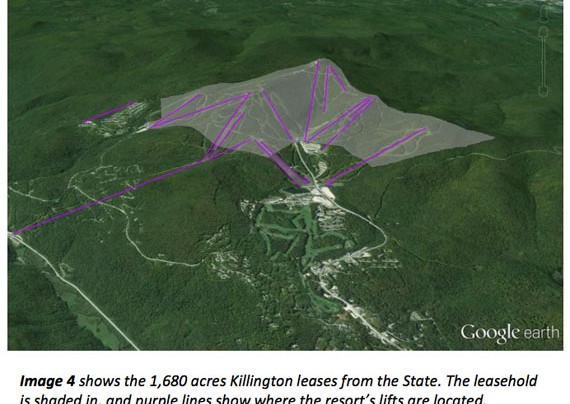 However, all those arguments put together, I cannot believe that he can argue in good faith that all of them together, they do not constitute the very proof of symbiotic-relationship! In Burton "the restaurant [Eagle Coffee Shoppe] was physically and financially an integral part of a public building, built and maintained with public funds, devoted to a public parking service" just as Killington Ski Resort is physically and financially an integral part of public land, maintained with public funds, devoted to public roads, water sources, fire and police services, rescue services, EMT services, all maintained with public funds.
I agree that the difference exists, since in Burton the state was responsible for direct maintenance of the building in which the restaurant resided, and Killington resort takes responsibility for maintenance of buildings, lifts, structures (even parking lots) on the land they lease from the state. I understood from the beginning that made my case weaker, but, after reading the Opinion and Order, my belief is even stronger in that the symbiotic-relationship exists in less direct ways. And, anyway, was there any other legal way to confront this odious No Trespass Notice? I felt I had no other choice. I certainly cannot stay silent in face of such gross injustice being done to me and my family.
Killington leases 1680 acres of prime hiking state land that includes the second highest peak in Vermont. As a landlord I understand that any lessee has the right of possession, and that courts like to emphasize that possession and not ownership is dispositive to the trespass charge, i.e. not even the owner has the right to enter without lessee's permission (which I also found verbatim in Vermont v. Gillard, 2013), so I would not presume considering Killington a state actor solely because it operates on leased public land.
In the light of that emphasis, I should bring forward that I think that the Killington Mountain Clinic was then improperly included in the No Trespass Notice I was issued, as the Clinic is in possession of the Rutland Regional Medical Center and the Vermont Orthopaedic Clinic, and not of the Killington Ski Resort (and doctors there gave me guarantees that they will not abide by the Killington's order). Does anybody care about that? Or are those people (Killington resort senior management) allowed to get away with just about anything?
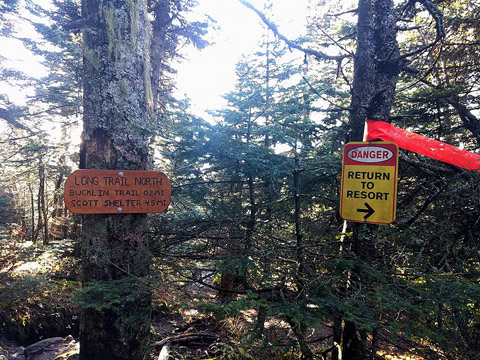 I would take in account that size of leased public land, and the uniquely high value of the land they actually control, as one of the factors that contribute to the proof of symbiotic-relationship between the resort and the state. The resort actually posts signage even on the public land outside of the 1680 acres they lease from the state, like on the Long Trail near Cooper's Cabin, warning off-piste skiers it is time to walk back, further proving the symbiosis. Does anybody care about that? Am I repeating myself?
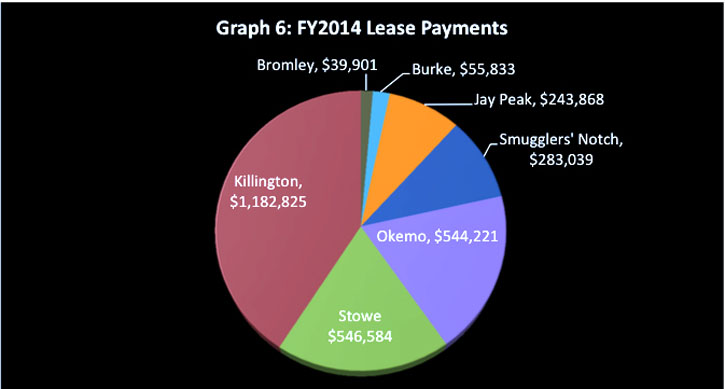
Killington is one of the seven lucky ski resorts in Vermont that got long medieval-feudal-lord-like leases on huge tracts of the most iconic mountain acreage in the mid-20th century. Actually, Killington has the longest lease of all of them: 100 years. This was very short sighted by the State, and all resorts are by now breaking the terms of their leases by expanding their activities far beyond their original stated purpose, as it was reported by the state auditor Douglas Hoffer in 2015: today the resorts make more money from other sources than from lift tickets sales, and they are all paying peanuts in rent in today's dollars. The property values at seven resorts rose 13 times the size of lease payments since inception. Killington leads in that loss for the State: from 1994-2014, adjusted for inflation, Killington lease payments dropped 37%, making its relationship to the State more parasitic than symbiotic, indeed.
The relationship is particularly and demonstrably parasitic in respect to the neighboring city of Rutland - on which Killington Resort depends for infrastructure, services, and labor. Recently I asked a friend how was it possible that Saratoga Springs, NY is doing so much better over the last several decades than Rutland, VT. Oh, that's easy, she said: they have the horse race track. But they had the horse race track since the 19th century. At the turn of century (19th to 20th), Saratoga Springs and Rutland had roughly the same population size. And by the late 1960-s, early 1970-s, Rutland grew in size bigger and faster than Saratoga Springs - regardless of that race track. Then Killington Ski Resort came into existence: an engine that should have propelled Rutland's economy even faster and stronger. Yet, the opposite happened. Saratoga Springs substantially outgrew Rutland since then, as Rutland experienced economic and demographic decline. It is as if the Resort sucked all life out of it. It is as if when Tracy Taylor moved to Rutland from Saratoga, that was the Saratoga's gain and the Rutland's loss.
The VT Department of Forests and Parks met with Killington’s new owners in the winter of 2008 to discuss that downward trend of the diminishing Killington's usefulness to the state of Vermont. The department said the new owners were not certain what caused this trend, as they didn’t oversee the resort during most of that time. Plausible deniability, of course. Between FY08 and FY14, however, lease payments continued to decline by 6.2% when adjusted for inflation. No audit or independent review of the situation has ever been conducted. It is unclear exactly what is driving this trend, but between 2012 and 2013 a parcel with a golf course and a mixed-use development dropped in value from $13.8 million to $1.4 million. I am not sure why this did not warrant and audit, but the State should really break those leases and change the terms. Although, I guess, this goes beyond the scope of this case.
Let's not digress further from the principal argument. Killington is not merely one among the seven: besides having the longest lasting lease, Killington is by far the largest among them, paying more than twice the rent paid by any other resort: 41%. And the State gains greater tax revenues if Killington's gross receipts increase. That certainly makes it a very valuable asset to the state and suggests a possibility of the collusion of interests. On top of that, lease payments are not the only receipts State receives due to existence of ski resorts. There is also Sales and Use tax, and Meals and Rooms tax.
 The growth in sales at the seven resorts has resulted in greater tax revenues for the State and two municipalities with a local options tax. From 2000 to 2013, sales and use tax revenues generated at the seven ski resorts increased 79%, from $4.4 million annually to $7.9 million. Meals and rooms tax revenues – which include alcohol – rose 129%, from $4.2 million annually to $9.5 million. In addition to these sales-based tax revenues, development on private property around the leaseholds generates revenue for the State’s education fund and for municipalities. Due in large part to the real estate development on private lands, the seven resorts generated $5.3 million in education taxes in 2013, and the resorts generated an additional $1.5 million in municipal property taxes.
Between 2003 and 2013, private property values at the seven ski areas grew by almost 150%, and, in 2013, the seven ski resorts generated nearly $5.3 million in property taxes for the State’s education fund, which pays for Vermont public schools. During that same decade, inflation-adjusted sales of meals at these resorts grew by 40%, alcohol sales grew by 49%, and rooms’ sales grew by 61%. The growth in combined sales has resulted in greater tax revenue for the State, and much of this tax burden is exported to non-residents who come to Vermont as tourists. It is important to note that the real estate development on private lands, that contributed to that growth, would not exist without the leased land that holds the lifts and ski trails, that are the reason for those tourists coming to Vermont. There is no doubt that the State benefits hugely from the Resort.
But also, the Resort benefits hugely from the State: there are tax advantages extended to those resorts similar to tax advantages Eagle Coffee Shoppe had through its arrangement with the State in Burton, with Killington, again, being the biggest beneficiary among the seven. Vermont statute exempts ski lifts, snowmaking equipment, and other resort machinery from state education taxes. Tax bills for the seven resorts show that $74.2 million in property was exempt from education taxes in 2013, half of that at Killington. That figure accounts for 16.4% of the resorts’ combined 2013 property values. This exemption resulted in roughly $1.1 million in foregone tax revenues for these seven resorts in 2013. This is the true symbiosis in action – the State benefits from the Resort, and in turn the Resort benefits from the State.
Highlighting that symbiotic relationship, Parker Riehle, the [VT ski] association’s president, told the Vermont Press Bureau that the leases are a "very good deal for both parties and very favorable" to the state (Vtdigger, 02/15/2015). And Killington town referred to that symbiosis in its Town Economic Impact Study of 2008: "The Town, SP Land Company and KPSRP should meet in a collaborative environment to address the issues, information and actions that need to be considered to allow the development to go forward. The development can evolve in a mutually beneficial manner for the resort and the community and build on the past symbioses between the mountain development and the community context while revitalizing the snowsports operation." In one Mountain Musings column in Mountain Times 2007, even (then) Killington CEO, Chris Nyberg, is quoted saying to the Killington town select board: "the resort needs a symbiotic relationship with the community - like... the friendly birds that live on the back of an elephant and pick the bugs off."
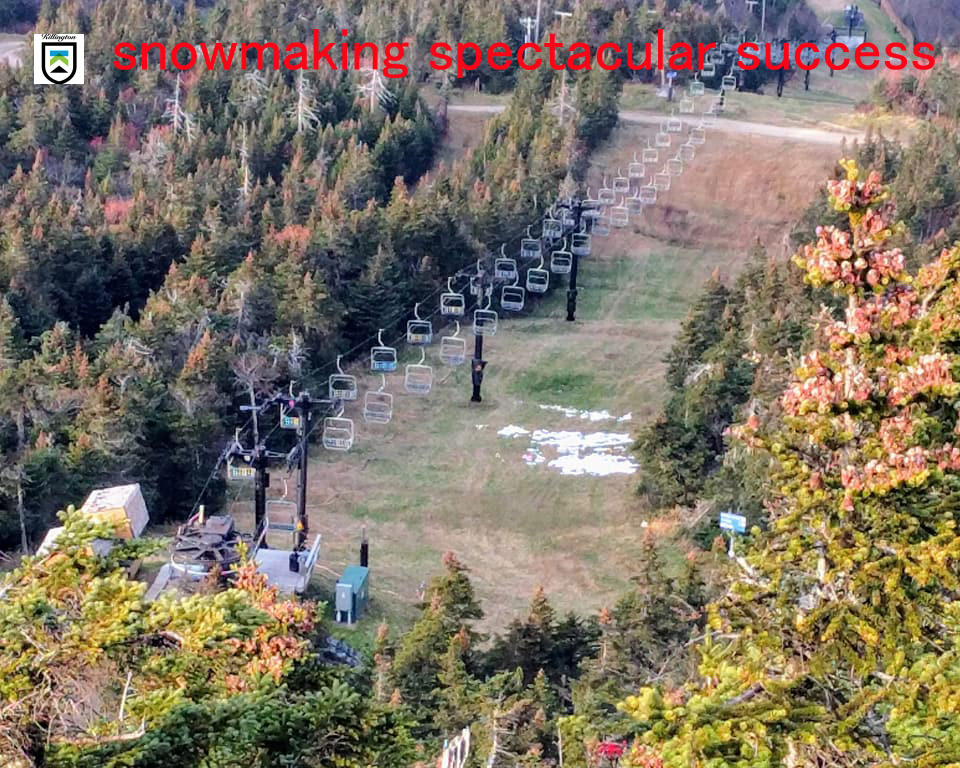 Judge Crawford argued that none of this by itself (leased public land, length of that lease, rent payments to the State that correlate to gross receipts, the out-sized value of Killington to the State compared to other resorts, the revenue State gets through Sales and Use tax, the Meals and Rooms tax, the property taxes that go to the State's education fund, the tax exemption Killington enjoys, the expansion of Killington activity on public land beyond their leasehold, the fact that the town, the community, and the resort management acknowledge that the symbiotic relationship between the private and the public interest indeed exists, etc.) is sufficient to forge a symbiotic relationship. I argue that all of that put together does forge such a relationship, and that because such relationship exists, Killington acted under color of State law, and consequently violated my constitutional rights under 42 U.S.C. §1983.
Furthermore, here is another test: if there is no collusion, if there is no symbiotic-relationship, then why does the State, and why do courts offer more protection to Killington, than to police officers, public employees, in the adjudicating enforcement of the same offense (No Trespass)? It is as if they are so beholden to the resorts' money that they hold the good of the resorts' management in higher esteem than the rights of citizens. Frankly, this is not what I would expect of the State that has Bernie Sanders as its US senator. But, here it is. Seven Days wrote on 05/07/2014: "One year after Burlington implemented a no-trespass ordinance that allows police officers to banish repeat troublemakers from the Church Street Marketplace, two things are clear: The ordinance appears to have succeeded in its stated goal, and its existence has never been in greater jeopardy."
The Burlington criminal court Judge Michael Kupersmith threw out a trespassing charge against the ordinance's most frequent offender. In that decision, the judge deemed the ordinance "unconstitutional." Burlington Police Chief Michael Schirling reacted: "This isn't barring people because we don't like them. All it's about is curbing behavior that adversely effects hundreds, if not thousands, of people, most of the people we are dealing with, all the efforts to change the behavior have failed. You have to work really hard to get a trespass notice. They are choosing not to engage in services that are offered to them again and again."
Why is Burlington city and Burlington police held to a higher standard on No Trespass orders than Killington Resort? Why would it be unconstitutional for the state or the city to no trespass someone from a public street for a year, while it would be perfectly constitutional for Killington to no trespass someone from all their possessions indefinitely? That's certainly morally awkward. And I heard rumors that Killington had issued dozens of such No Trespass Notices over the years against local people that the resort's senior management disliked for whatever reason. Yet, Killington was never asked, neither offered any shred of proof, any tiny bit of evidence that their behavior adversely affected hundreds, if not thousands, of people, Killington's guests, and employees!
 Did I ever disrupt or threaten their ordinary conduct of business? What are their legitimate concerns? Here are mine: their notice destroys my family (as my wife still works there, and my son snowboards there, and I cannot be with them), it deprives me of the primary reason why I came to live in Vermont, it causes severe stress to my child, while I was not given a legal remedy, neither there was any due process (where I would be able to argue about the validity of the No Trespass order), nor there is any hint whatsoever about the reasonable duration of that adverse order.
My rights were violated. My family and I suffered irreparable harm at the hands of the Killington Ski Resort. And, to make my injury worse, I am not receiving any relief or protection from the law. An order of injunctive relief would be highly appropriate in this case, for example. On the other hand, judge Crawford's decision not only does not grant such a relief, but also specifies that any appeal to his Opinion and Order dismissing my complaint would not be taken in good faith, which sounds to me just like pandering to big capital. All things considered, the very speed of his response becomes suspect, too. As if he rushed to promptly shut down such blasphemous thinking that a ski resort could do any harm to an individual, least I get encouraged! And where did the good judge get that Killington Ski Resort was my former employer? This is brought up prominently in the first sentence of his Opinion and Order. Yet, I did not mention this anywhere in my original complaint, and it is also very old news, irrelevant for my claim: I have not worked for Killington Ski Resort since 2005, so for more than 12 years.
I am very upset. I am very disappointed. Maybe I made a mistake making my home and rising my child here. Twenty wasted years. But since the judge made it so abundantly clear that my hopes to resolve this matter through legal means were futile, I guess I will have to resort to other means. I will certainly make sure that my un-filed appeal of this decision in this matter is shared, remembered, and discussed. I should add that what I wrote originally about this experience, while always promptly deleted from the locals facebook groups, elicited some response among many people I know at Killington. There was sympathy for my suffering. But there was also prevalent fatalism in thinking that nothing can be done, and the hope that I would just accept my fate and go away. A lot of people locally have their lives and their fortunes entangled with the fortunes of The Beast, just as I did, if not more. They don't want the Resort to fail, or to be shown in a bad light, that would hurt its business, and maybe then hurt them. A bad year for the resort, is a bad year for them, they reason. And I am certainly sorry that I cannot share in their enthusiasm any more.
The parts of this letter, colored orange, were highlighted on the copy - of the version of the text above, that I sent as a Public Statement to the Court, in lieu of a properly filed appeal - brought to me on 11/02/2017 by two US Marhalls, that just wanted to check on me, how am I doing and all. And also to clarify the "other means of redress". They left me a copy of the Suicide Prevention Center leaflet on their way out. That's the best the law can do for me right now. Fair enough. So, here: I told them I intended those means to be legal. Remedies may be legal even when they are not legal remedies. Mainly bringing public attention and shame through the media and social networks for now, and I did already contact several VT media with this story.